Product Details
Product Description
Product Description
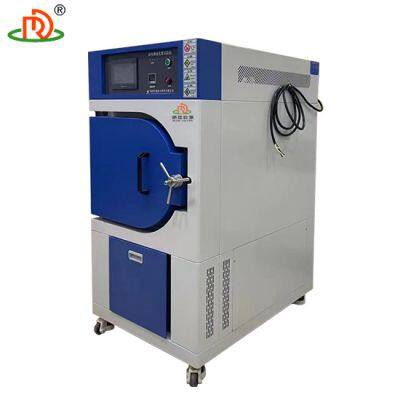
Here are the basic parameters of the HAST (High Accelerated Stress Test):
ParameterDescription
| Temperature Range | 50°C to 150°C |
| Humidity Range | 50% RH to 98% RH |
| Pressure Range | Up to 2 Atmospheres (maximum) |
| Acceleration Factor | About 10 to 1000 times (based on temperature and humidity conditions) |
| Test Duration | Adjustable, typically from 24 hours to 1000 hours |
| Temperature Accuracy | ±0.5°C |
| Humidity Accuracy | ±3% RH |
| Internal Volume | From 100L to 1000L |
| External Dimensions | Varies by model, typically 600mm x 600mm x 1200mm |
| Power Supply | 220V, 50Hz / 60Hz |
| Safety Features | Automatic protection against overpressure, overtemperature, overhumidity, short circuits, etc. |
In the HAST (High Accelerated Stress Test) high-voltage accelerated aging test chamber, the failure mode of semiconductor devices is mainly due to the combined effects of extreme environmental conditions such as high temperature, high humidity, and high voltage, which lead to aging and damage of internal materials and structures of the devices. Here are some common failure modes of semiconductor devices:
1. Metal migration and electromigration
Electromigration is due to the fact that when semiconductor devices operate at high voltage, current passing through metal wires may cause the migration of metal atoms, resulting in damage or short circuit of the metal wires. This phenomenon usually occurs under high current density or long-term operation conditions, and in HAST testing, electromigration is exacerbated.
Failure manifestations: open circuit, wire breakage, metal layer detachment, short circuit phenomenon, etc.
2. Solder joint failure
Solder joints are prone to aging and damage in high temperature and humidity environments, especially due to the expansion, contraction, and corrosion of welding materials caused by high temperature and humidity conditions.
Failure manifestation: Welding point fracture, cold welding, virtual welding or peeling of welding layer, resulting in poor connection or even short circuit.
3. Material aging and delamination
In high humidity and high temperature environments, packaging materials for semiconductor devices, such as epoxy resin and silicone, are easily affected by moisture, leading to aging, cracking, or delamination. This situation often occurs when the packaging is incomplete or the material itself has poor quality.
Failure manifestation: Cracks, delamination, water leakage, or penetration of conductive substances in the packaging material, leading to a decrease in electrical performance or even a short circuit.
4. Electrical overload and breakdown
High voltage and high temperature conditions can intensify the strength of the internal electric field in semiconductor devices, which may lead to electrical breakdown, especially in cases where insulation performance is insufficient. Especially in high humidity environments, moisture can reduce the insulation effect and accelerate breakdown.
Failure manifestation: insulation layer breakdown, resulting in current leakage, short circuit, or complete device failure.
5. Corrosion caused by moisture
In the HAST test, the combination of moisture and pollutants in the air (such as chlorides, sulfides, etc.) may cause corrosion of the surface metal of semiconductor devices, especially on the surfaces of contact terminals and circuit boards.
Failure manifestations: poor contact caused by corrosion, increased resistance, and decreased performance.
6. Mechanical failure caused by thermal stress
High temperature and humidity can cause the expansion and contraction of semiconductor device materials, especially when the expansion coefficients between different materials do not match, which may lead to stress concentration, resulting in cracks, fractures, or other mechanical failures of the device.
Failure manifestations: cracks, fractures, packaging cracking, poor metal contact, etc.
7. Charge accumulation and parasitic effects
In high temperature and high humidity environments, charge carriers inside semiconductor devices may accumulate, leading to changes in parasitic capacitance or inductance. This accumulation effect may affect the normal operation of the device, especially in high-frequency circuits.
Failure manifestation: significant decrease in the switching characteristics, frequency response, and electrical performance of the device, leading to circuit failure.
8. Potential Induced Attenuation (PID)
This phenomenon is more common in semiconductor devices in photovoltaic modules, but it can also be applied to other semiconductor devices. High voltage and moisture can cause potential induced degradation (PID) of equipment, especially when a potential difference is formed between metal and silicon materials, which may accelerate aging or performance degradation.
Failure manifestation: equipment efficiency decreases, open circuit voltage and short-circuit current decrease, resulting in severe performance degradation.
9. Thermal failure and temperature overload
In HAST testing, long-term exposure to high temperature environments may cause semiconductor devices to overheat due to poor heat dissipation or internal heat accumulation, resulting in thermal failure. Especially in power semiconductor devices, excessively high operating temperatures can cause damage to transistors or diodes.
Failure manifestation: Dead zone, short circuit, damage or functional failure caused by overheating.
10. Oxidation and electrolysis reactions
The high humidity and high voltage environment intensify the oxidation reaction on the metal surface, especially in the absence of effective sealing, which may lead to oxide or electrolytic reactions on the electrode surface, affecting electrical connections and conductivity.
Failure manifestations: surface oxide formation, electrode failure, increased resistance, and even short circuit.
Conclusion:
In the HAST high-voltage accelerated aging test chamber, the fundamental cause of semiconductor device failure is the combined effect of multiple environmental factors, especially the combined effects of high temperature, high humidity, and voltage. By analyzing these failure modes, important references can be provided for the design, packaging, and material selection of semiconductor devices, helping to improve their reliability and long-term stability.
>>
Basketball Shooting Game Machine for Entertainment
>>
Xh-W3001 Microcomputer Temperature Controller 12V 24V 220V Intelligent Temperature Controller
>>
Timing Chain Kit for Mazda 3 5 6 Engine B2300 2.3L Timing Kit TK1155-2
>>
Customer colorfull Hair Accessories Elastic Ribbon Hair rope printed fold over hair tie Bracelet
>>
Sucralose CAS No. 56038-13-2 E955 Splenda
>>
CNC Machining Service Turning Milling Hobbing Gear Manufacturer High Precision Gear Wheel Gear Shaft
>>
Failure modes of semiconductor devices in the HAST high-voltage accelerated aging test chamber
>>
Hot Security Guard Patrol GPS GPRS RFID Device Patrol Wands Security Checkpoint
>>
professional custom CNC machining Eco-friendly cheap price Aluminum parts for coffee machine parts
>>
Alchemy Cosmic Light Bowl clear crystal singing chakra holy grail
>>
Optical Colposcope for Medical Vaginal Exam
>>
High Purity Zinc Ingot Made in China HEN Dimensions ICP Pcs Weight Form Origin Chemical Product Min Place Pressure Model Lit
>>
2021 OEM Custom Tool Retractable Expandable Green Water Pipe Reel Garden Water Hose
>>
Low Attrition Rate High Speed N95 Respirator N95/FFP3 Face Mask Making and Packing Machine
>>
Wishbone S-type Suspension Parts High Quality Upper Control Arm For XF (X250) xr857883
>>
Double Sockets Petrol Engine Rail Bolt Wrench
>>
High Quality Sugar Cashew Nuts Chocolate Tablet Panner Small Candy Pharmaceutical Tablet Coating Pan Machine
>>
90*4W RGBW 4in1 Multi-Color LED Moving Head
>>
Highest Quality New Lime Kiln Vertical Shaft & Rotary Kiln for High-Quality Quicklime
>>
100% Plastic Polyethylene Tarpaulin Waterproof Heavy Duty Roof Green Tarp