Product Details
Product Description
Product Description
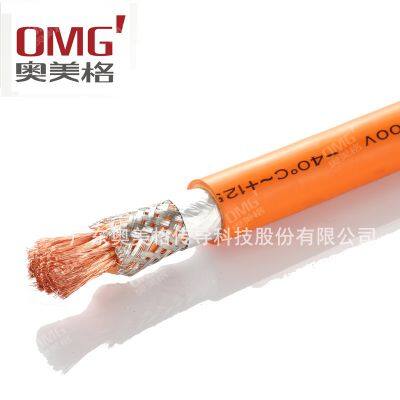
Product introduction: The selection of insulation materials mainly considers heat resistance requirements and mechanical strength. Compared with standard battery cables, softer materials can be reasonably selected to keep the specially designed stranded conductors flexible.
The basic difference from conventional automotive cables is that the structure needs to be designed for a rated voltage of 600 V, while if used on commercial vehicles and buses, the rated voltage can be as high as 1000 V or more. The cables currently used in cars driven by internal combustion engines are designed for a rated voltage of 60 V.
Function: For all insulating materials, such high voltages have never been a challenge. For industrial and civil electrical systems, this is still low voltage. For automotive high-voltage cables, the challenge should be in thermal and mechanical properties.
Because the cables connect batteries, inverters and motors, high-voltage cables need to transmit high currents. Depending on the power requirements of the system components, the current can reach 250A to 450A. Such high currents are difficult to find on conventionally driven vehicles. The result of high current transmission leads to high power consumption and heating of components. Therefore, high-voltage cables are designed to withstand higher temperatures. At present, it can be seen that there is a trend of further increase in temperature requirements.
In summary: In contrast, the current vehicles usually use cables with a rated temperature of 105℃, which is sufficient, as long as the cables are not used in the engine compartment or other areas that can withstand higher temperatures. Electric vehicle high-voltage cables are usually higher than this temperature, such as Class C (125℃) or Class D (150℃). If the route through the electric vehicle is unfavorable, such as near the exhaust pipe, in front of the motor, on the back of the battery, etc., the OEM will even put forward higher high temperature resistance requirements. Such as Class E (175)℃. The higher heat resistance of the insulation material determines that the cable can carry a higher rated current. Please search and visit: OMG EV cable
>>
Mass Production CNC Machined Industrial Turning Drawing Stainless Steel CNC Machining Part
>>
Bcmc Automatic 3D CNC Router Series Stone Carving Machine Engraving Stone Pillar Machinery Price Stone Curving Machine
>>
2022 hot sale High quality wholesale commercial bamboo steamer for food cooking basket
>>
Rose Gold Silver Women Adult Size Metal Twistable Swimwear Swimsuit Bikini Hanger
>>
2711P-T12W22D8S Allen-Bradley PanelView Plus 7 Standard operator terminal
>>
China Factory Sales 4X2 Compact Kitchen Garbage Truck Mini Garbage Truck Hot Sell
>>
Scwn-Q200 Fluidized Bed Air Jet Mill
>>
High-Precision Injection Molding Machine for Plastic Toy Making Fruit Basket
>>
Timing Chain Tensioner for BMW OEM 1738700 11311738700 TN1068
>>
2022 Fashionable High Quality New Arrival Men Track Suit Custom Design Men Jogging Wear Tracksuit
>>
Disposable Pushbottonhigh Speed Dental Dentist Essential Tool Handpieces
>>
Men Fitness Wear Tank Top Custom Made Tank Top Custom Printed Logo Tank Top For Men
>>
SPA Equipment Vichi Shower Water Shower Massage Bed with LED Light Therapy
>>
Solid Wood Waterproof High Quality Outdoor Common Bench
>>
2024 New Model Custom Design Modular Cheap Kitchen Cabinet with L Shape/I Shape/G Shape
>>
Straight Seam Welded Steel Pipes Tube Mill Machine Used on Steel Tube Factory
>>
Stainless Steel 304 Home Security Privacy Mortise Front Entrance Door Lock
>>
Band Brakes
>>
Hg219 High Frequency ERW Steel Tube Mill/ Tube Mill Machine/High Frequency Welding ERW Steel Tube Mill
>>
Best-Sell High Quality Organic Vegetable Condiment Seasoning Air Dried Ginger