Product Details
Product Description
Product Description
1. Manufacturing Technique
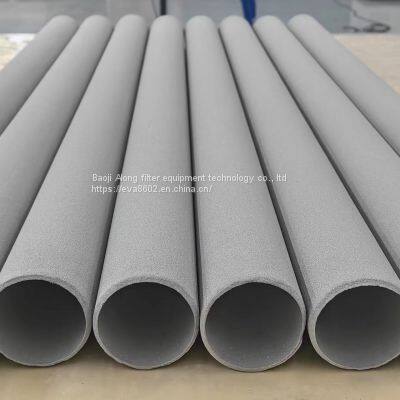
Stainless steel 316L sintered porous material is stainless steel 304, 304L, 316, 316L powder as the raw material, after screening, molding, sintering microporous material.
Feature: Stainless steel sintered porous material has excellent corrosion resistance, oxidation resistance, wear-resistance and mechanical properties.
2. Specification of stainless steel sintered porous materials
| Material | Filter Rating | Porosity | Penetrability | Working pressure | Operating temperature | Shape | specific surface area |
| 304,304L,316, 316L Stainless steel powder | 0.5um-70um | 30-45% | 3-1300M³/M²hKPa | 3.0MPa | 600℃ | Round Disc, Sheet, Tube, Round Bar, cap. | 10-40cm²/cm³ |
| Production | (Diameter)Length | (Diameter)Width | Thickness | Customized |
| Sintered porous round discs | φ5-φ300mm | φ5-φ300mm | 0.5-10mm | Yes |
| Sintered porous sheets | 5-300mm | 5-300mm | 0.5-10mm | Yes |
| Sintered porous tubes | 100-1200mm | φ20-φ200mm | 1-10mm | Yes |
| Sintered porous cartridge | 100-1200mm | φ20-φ200mm | 1-10mm | Yes
|
3. Properties of stainless steel sintered porous materials:
High-temperature resistance, in normal use under 500 ℃.
High mechanical strength, good plasticity, can be machined.
Corrosion resistance, oxidation resistance, can be used in nitric acid, sulfuric acid, dilute hydrochloric acid (5%), acetic acid, liquid hydrogen, liquid nitrogen environment.
Good molding process, according to customer drawings for processing a molding.
High filtration precision and good purification effect.
The pores are uniform, the internal structure is stable, and no particles fall off.
Good air permeability, easy to back blow cleaning, can be used repeatedly online regeneration.
Wear resistance and impact resistance, good mechanical properties.
4. Application of stainless steel sintered porous materials
According to its physical and structural characteristics, stainless steel sintered porous materials are mostly used in the fields of noise elimination, filtration and separation, fluid distribution, flow-limiting, capillary core and so on.
The chemical raw material production process in addition to impurity filtration, material decarburization filtration, and fine filtration.
Ultrafiltration, RO, EDI system security filtration in water treatment.
The food and beverage industry finished product clarification filtration.
Filtration and recovery of the precious metal catalyst in the petrochemical industry.
Precision filtration of liquid raw materials, products and pharmaceutical intermediates in the chemical industry.
Reverse osmosis security filtration in the field of water injection filtration.
Gas purification of steam, compressed air deoiling purification.
Medium purification and flow limitation for pneumatic components, lubricants, fuels, and hydraulic pressure systems.
Chemical dye industry of high - temperature decarburization.
5. Stainless steel sintered porous materials are allowed to use in the environment
Nitric acid, sulfuric acid, acetic acid, oxalic acid, phosphoric acid, 5% hydrochloric acid, molten sodium, liquid hydrogen, liquid nitrogen, hydrogen sulfide, acetylene, hydrogen, carbon dioxide gas, water vapor, etc.
6. Precautions for the use of stainless steel sintered porous materials:
During installation, disassembly and clean avoid scratches, collisions and falls on hard objects.
When using, the filtrate is filtered from the outside in to avoid the reverse direction.
Avoid instant pressurization when the filter element works.
When the filtration efficiency is less than 50%, the filter element should be cleaned in time.
When cleaning the filter element, the first backflow with pure gas, backflow pressure is 1.5 times the working pressure, each time for 3-5 seconds, and 4-6 times, then backwash with clean liquid for 3-5 minutes, repeat 2-3 times.
If the filter element is not good after online back blowing and backwashing, it should be removed and cleaned in time.
7. Method for cleaning stainless steel sintered porous materials
The decarbonization filter elements in the pharmaceutical and chemical industries are mainly back blown and back washed, and the ultrasonic cleaning is the best.
The filter elements of the water industry are mainly rinsed with a 5% concentration of nitric acid.
According to the chemical properties of the filtered impurities, the filter elements of the original liquid shall be respectively soaked in pickling (5% nitric acid) or alkaline washing (3-5% sodium hydroxide) and then washed with ultrasonic cleaning.
Production Steps:
8. Main products list
>>
Professional Wood-Working Forest Timber Log Splitter
>>
JIMBO China home steel american digital office key lock fireproof cabinet safe
>>
20FP22H1CT-R BATTERY 20FP25H1CT-R AZERBEYCAN
>>
dB-6146 Series CNC Lathe for Complex Machining Tasks
>>
Flotation process agent mixer tank
>>
Cw6180 Heavy Duty 3m Lathe Machine Metal Manual Lathe Machine with 2 Axis Dro
>>
Fishing Rod Shock-absorbing Keel Sweatband Badminton Tennis Slingshot Anti-slip Overgrip
>>
DC12V 500mg/H Air Water Purifier Portable Ozone Generator with Vegetable Washer
>>
high quality car accessories the full LED headlamp headlight for audi A8 head lamp head light 2014-2017
>>
Automatic Operation High Efficiency Mixing Machine CH-500 Trough-Type Mixer
>>
Electric Motorcycle Motorcycle Bluetooth Helmet Men′s Open Face Helmet Double Lens Full Helmet Running Helmet Safety Helmet 008
>>
Affordable Used PC360-7 Crawler Excavator for Sale
>>
Baby towel 100% cotton muslin towel handkerchiefs four layers wipe towel
>>
470mm Automatic Blin Precision Lathe CNC Turning and Milling Center
>>
For XCMG excavator parts loader parts Construction Machinery Parts
>>
Hand Crank Bread Dough Mixer Kneading Machine Dough Heavy Duty Dough Mixer
>>
China A4 80GSM Inkjet Copy Printer Copier Paper
>>
Automatic Making Production Line for Aerosol Valve Snow Spray Can
>>
OEM ODM Shimmer Glitter High Pigmented Multi-Used Lip Face Eye Shadow Stick Eyeshadow Pen
>>
AC-B244F-2440Y1 UTERS replacement of Pall hydraulic oil filter element